Single-phase Direct-to-Chip Cooling
The coolant remains liquid as it absorbs heat from the chip, with its temperature rising as it flows through the cold plate. Heat is carried away through sensible heat transfer.

Two-phase liquid cooling delivers high-efficiency, chip-level heat removal for high-power CPUs and GPUs, enabling higher thermal density and scalable data center deployment.
As processor power and heat flux continue to rise, conventional single-phase cooling faces increasing demands on coolant flow and heat-transfer capacity. Two-phase cooling uses the latent heat of phase change from liquid to vapor to absorb more heat with less reliance on coolant temperature rise.
CPU/GPU generates heat in working.
Coolant reaches the chip surface, facilitating bubble departure and liquid replenishment.
Drives the phase-change coolant and enables condensation and heat exchange.
Controls coolant flow and phase conditions.
Connects to the primary cooling source for heat rejection, enabling free cooling and high-density deployment.
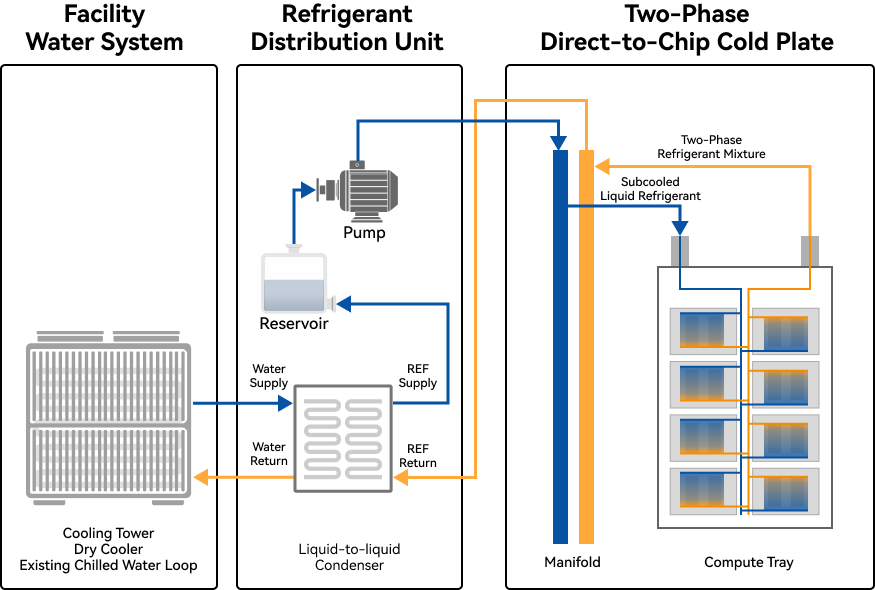
As processor power and heat flux continue to rise, conventional single-phase cooling faces growing demands on refrigerant flow and heat-transfer capacity. Two-phase direct-to-chip cooling harnesses liquid-to-vapor phase change at the cold plate to handle high chip heat loads with lower coolant flow requirements.
The coolant remains liquid as it absorbs heat from the chip, with its temperature rising as it flows through the cold plate. Heat is carried away through sensible heat transfer.
The refrigerant boils at the chip surface, absorbing latent heat as it transitions from liquid to vapor. The vapor carries heat away, allowing high heat loads to be handled with lower refrigerant flow requirements.
Cold plates capture heat directly from CPUs and GPUs for targeted, high-density cooling.
Best suited for:Dielectric fluid surrounds submerged IT components, removing heat directly from component surfaces.
Best suited for:Not sure which cooling approach fits your needs? Talk to our cooling experts to find the right solution for your application.
The coolant flows through optimized channels inside the copper cold plate to remove heat from the chips. The low-flow-resistance design helps balance cooling performance and circulation efficiency.
Learn more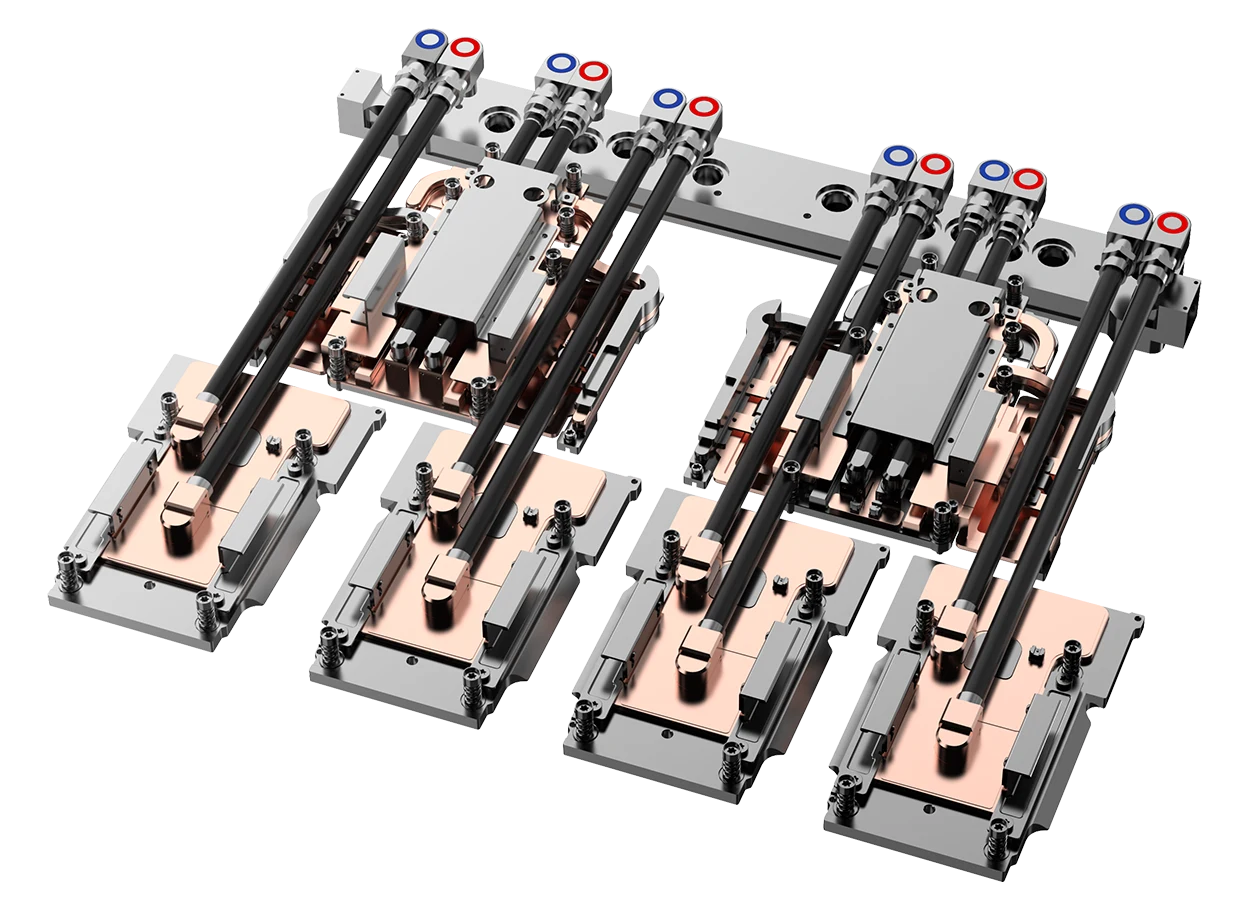
SynthCool’s Landau 2PCP series two-phase liquid cooling solution combines two-phase cold plates, a dedicated two-phase RDU, and manifolds into an integrated cooling system, supported by optimized system controls. By leveraging the latent heat absorbed as the refrigerant boils inside the cold plates, the solution efficiently removes heat from chips while supporting high heat flux and uniform temperatures across multiple nodes.
Learn more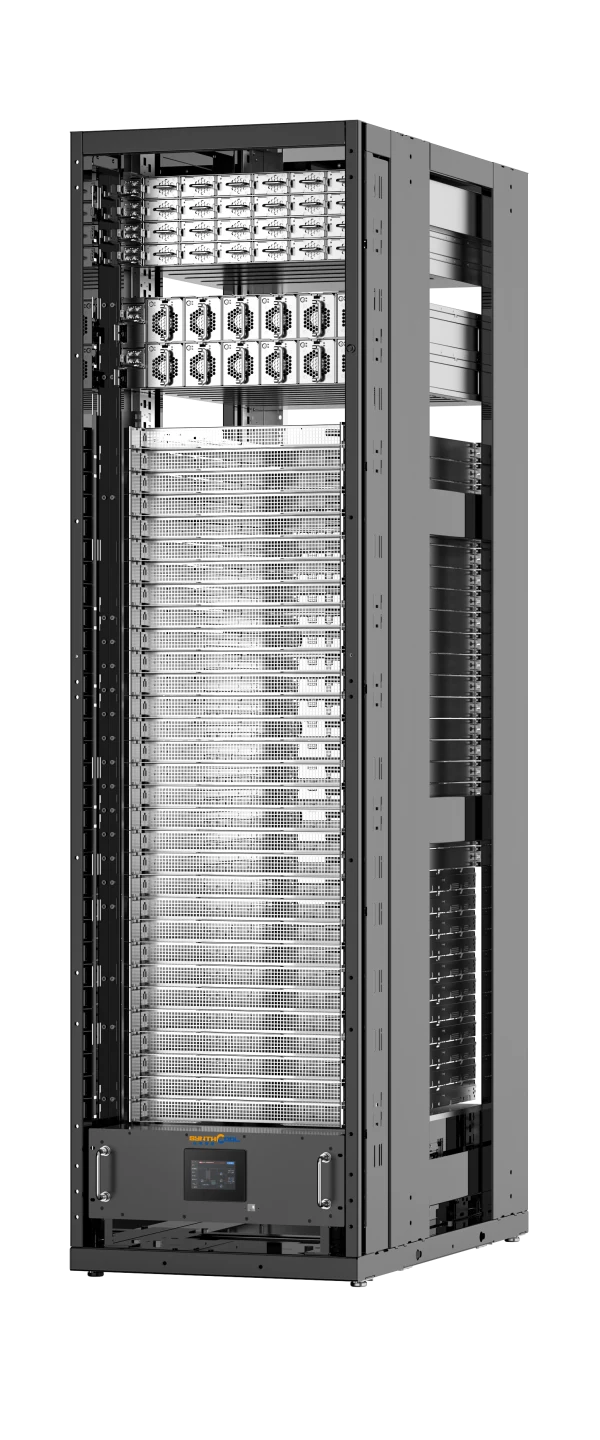
Talk to our experts about your thermal challenges and cooling requirements.